Thursday, May 24, 2012

Moral Failure (Before a Watching World)

Moral Failure (Before a Watching World)

There have been few things more damaging to the church’s witness than how it has handled moral failure among its leaders.  Not simply that there has been moral failure – that is damaging enough – but how it is then handled by the church.  Too many times it has simply added to the pain and disdain.  Whether pedophiles, serial adulterers, or those who misuse church authority and discipline, headlines and blogs are filled with understood outrage and indignation over not simply the acts, but the church’s response.
 
So why do so many churches bungle moral failure among leaders?  For some, it’s true ignorance.  They honestly don’t know what is best to do, never received training or mentoring, and are having to make it up as they go.  One of the most common “mentoring” phone calls I receive from younger pastors is how to deal with moral failure when it hits their leadership team.
 
But we have to be less generous to what may be the most common reason for mishandling a moral failure:  churches and individuals are trying to self-protect, even at the expense of victims.
 
They are trying to protect giving, support, attendance, and reputation.  But lost in that “protection” are those in the future who might be abused by a serial pedophile, spouses that will see their marriage ripped apart by a habitual adulterer, and an ever growing number of church attenders who will be hurt by the ongoing spiritual abuse of leaders who seem to be given over to pride and anger.
 
So how should a church handle moral failure?
 
Here is a ten-step strategy forged over twenty-five years of ministry that I have often shared with younger leaders that will protect the abused, both confront and, if they allow it, care for the offender, and ensure the church’s integrity:
 
1.      Determine whether this is something that should be reported immediately to the authorities.  For example, ANY situation where a child has been sexually or physically abused should be reported to the police at once.  If it is a matter that does not involve the authorities, and they simply flee your church upon being revealed, do not in any way enable them to simply go to another church and continue their sin against others.  You may be limited as to what you can do, but do what you can to prevent them from being one of those who go from church-to-church, fleeing discipline and accountability, leaving a trail of bodies in their wake.
 
2.      Reflect on how the immorality surfaced.  Were they discovered, or did they come forward on their own?  This is your first sign as to whether there is true repentance at hand.  A situation where someone confesses, and repents, because they were “caught” after months or years of “covering up” is very different than someone who comes forward on their own out of conviction.
 
3.      Is their failure habitual, or a seeming one-time offense?  There is a significant difference between, say, a serial adulterer as opposed to a “one-night-stand” affair.  In other words, was the offense an anomaly in light of a steadfast track record over a long period of time, or is this a repeat offender?
 
4.      Was this offense of a completely disqualifying nature for their ministry role, or are they restorable?  In my judgment, someone who is unfaithful to their spouse one time in the context of years of commitment, can be restored.  A serial offender cannot (or perhaps more to the point, should not).  I would also argue that any offense against a child is grounds for permanent removal from any type of ministry with children.  That is a “one-strike-and-you’re-out” offense.
 
5.      If the person shows the kind of authentic repentance that seeks restoration, then resolve to have any and all discipline be restorative and not punitive.  Too many churches have discipline that is meant to punish, not redeem and restore.  The main purpose of church discipline is to drive the unrepentant toward repentance.  If repentance is there, then move into restoration.
 
6.      During restoration, it is usually wise to remove the person from any and all public platforms and leadership positions.  If kept in employment, it should behind-the-scenes and free of spiritual responsibility.
 
7.      The time of restoration depends on many things, including the kind of counseling that may be required.  For matters of sexual immorality involving another person, I would suggest six months minimum, but perhaps one year maximum.
 
8.      Communicate the situation to those who need to know.  This is delicate, as there are many innocent parties involved who may not wish the details to be divulged (e.g., the family of the child so abused, the wife of the unfaithful spouse).  There is also the family of the offender who, in most situations, are also victims (you do not want to unnecessarily embarrass the daughter of an adulterous man removed from ministry).  I would advise to share details with the relevant circle of that person’s influence and ministry.  This means that the wider the influence and ministry, the more people have to be told.  If it was a small group leader, that person’s small group should know, and perhaps other small group leaders in that ministry, but not necessarily the church as a whole.  Of course, there are certain individuals and offenses that warrant an announcement to the entire church body and, perhaps, to the rest of the watching world.
 
As far as the details of the offense itself, be direct and truthful, but not salacious.  I certainly wouldn’t share anything that caters to the prurient.  Also, in fairness to the person at hand, if it wasn’t sexual, don’t use language that suggests it was.  The term “moral failure” will always intimate sexual matters to the average person, so if it was financial or some other matter, find other language that is more to the point.  But the bottom line is appropriate disclosure to the appropriate people.
 
9.      If they are able to be restored due to the nature of the offense and their repentance, then they should be fully restored with joy and celebration as a Kingdom victory.  This is as important for the watching world as how we deal with the sin on the front-end.  Grace is our secret weapon against the world’s value system, and it shouldn’t be cheapened in our giving any more than our receiving.
 
10.    Those who have fallen, and then restored, should be received into the community as such.  There should be no “scarlet letter” on their chest from that point forward.  (*Again, matters related to child abuse are a different matter, as I would never suggest allowing them back into that particular ministry again, regardless of the restoration).
 
It goes without saying that not only is this list far from exhaustive, but every situation is unique and will require great prayer, counsel, wisdom and discernment.  But hopefully this will serve as a helpful set of guidelines.  And if you have some that are of value to add, please share those in the comments section of the blog.  You may not need them now, but make no mistake – there will be moral failure in the church.  It will happen within your leadership, and the world will be watching.
 
The key is what they will see.
 
James Emery White
 
  
Sources    
 
For additional counsel on this and related matters, see James Emery White, What They Didn’t Teach You In Seminary (Baker).
 
 
Editor’s Note
 
James Emery White is the founding and senior pastor of Mecklenburg Community Church in Charlotte, NC, and the ranked adjunctive professor of theology and culture at Gordon-Conwell Theological Seminary, which he also served as their fourth president.  His newly released book is A Traveler's Guide to the Kingdom: Journeying through the Christian Life (InterVarsity Press).  To enjoy a free subscription to the Church and Culture blog, log-on to www.churchandculture.org, where you can post your comments on this blog, view past blogs in our archive and read the latest church and culture news from around the world.  Follow Dr. White on twitter @JamesEmeryWhite.

Sunday, April 29, 2012

What Should We Do When We Feel Insignificant and Worthless

One of the toughest things in life is the feeling of being useless and therefore insignificant. When it seems like nobody appreciates us anymore and a sense of worthlessness sweeps not only over our countenance but our souls. It is much easier to be physically handicapped than it is to feel this sense of worthlessness - as though we have nothing of value to offer to anyone. That leads to depression and deep inside, we suffer a quiet deprivation and silent grief.

What should be done to get rid of this struggle within our souls for significance and recognition? The realistic approach is to face this head-on. It seems so ridiculous but to ignore or avoid it is just as ridiculous. The monster that we fear always hides under our bed. The demon that we dread always hides in our shadow. This unwelcome intrusion into our consciousness must be encountered with the presence of Christ.

When the deep darkness of our lonely struggle seems to overwhelm, the light of Christ shines ever brighter. Though we do not see or even feel His light but it shines in our rejection. We may want to control the intensity of that light and make it brighter for us to experience but the gentle hands of Christ guide our hands away from the control. He will shine accordingly and He will flood our life. His light is not to blind our rage and screen our fear. His light is to expose these and then replace them forever. He says, "Peace be with you, my child and rest well in my sweet embrace". When we learn to let go of ourselves to Him, we inadvertently let go of our misery too.

Long time ago, He had already seen our needs and that was why through the Holy Spirit, He placed this loving voice in Matthew 11:28, "Come to me, all you who are weary and burdened, and I will give you rest".

The Lord understands us so thoroughly that He placed promises in His ancient manuscripts to assure us that long before we feel the rejection, He had provided the answer.
"Though my father and mother forsake me, the LORD will receive me." (Psalm 27:10). 

"Can a mother forget the baby at her breast and have no compassion on the child she has borne? Though she may forget, I will not forget you!" (Isaiah 49:15).


Look at a very insignificant man, Blind Bartimaeus, who was rejected by society and struggled alone in his blindness and poverty. Are we in a worse condition than he was? 

Handicapped and totally rejected - even his cry for help was rejected by the people around him. They told him to shut up but the poor man had been silent for a very long time.
For years, he feebly voiced for a few small coins so as to put some food into his hungry stomach.

For years, he was pushed around and even abused when he accidentally blocked the way of some important people.
For years, he walked to his little corner in the whole wide world and sat alone in the sun, hoping for a kind soul to drop some spare change.

For years, he felt that he was a nuisance and contributed nothing to society.

In the midst of his misery, his alert ears had picked up many rumours from passersby about a miracle-making prophet, Jesus. Then the moment that changed his future suddenly appeared.

The crowd was shouting that the miracle man was passing by. That was when this beggar decided that enough was enough. He refused to be silent anymore and began shouting - making a desperate plea for his miracle, "Jesus, Son of David, have mercy on me!" (Mark 10:47). In that momentous encounter, the loving words of Jesus took away the scale that covered this man's eyes and soul. He was significant after all. Who had such a privilege to be heard by the mighty Creator of the universe? His eyes were opened and the first person he saw was his benefactor - Jesus. He then followed Jesus along the road (Mark 10:52).

The Light passed by Jericho that day and it was a blind beggar who caught that Light.

In our struggle for significance, we have few choices. We can wallow in the mud of our misery and allow the weight of this immense burden to squeeze the spiritual life out of us or we can look for the Light. We can search high and low in all the wrong places and wrong people for our significance or we can catch the Light. Today, thankfully the Light is not passing by because He is here to stay. We are allowed to cry to Him but we are not allowed to keep crying as though He is never here with us.

"And surely I am with you always, to the very end of the age." (Matthew 28:20).

When He holds us in His gaze and reaches to heal, we should bow and be quiet. Even inside of us, the tumultuous storm rages, but we have to be patient for that loud voice of authority. "Peace, be still" will soon echo over our inner trepidation. The miracle will happen in the midst of our silent struggle.

His peace is an overwhelming peace! Our inner healing will begin in the peace or 'shalom' of Christ. Instead of embracing our pain, we now can embrace the Healer of our pain. Instead of looking for temporal comforters, we have been promised the Holy Spirit who is our everlasting Comforter (John 14:26). The world cannot reject us because we do not belong to it. We belong to the most high God - the Lord Jesus Christ.

Prayer: Father in heaven, I pray for my friend who is reading this article to feel your love. I pray that he or she will experience you in such a personal way. Even though my friend may feel loneliness and insignificant in many ways, but I know that you will speak to his or her heart right now. Thank you, Lord, for loving my friend and letting him or her know that he or she is forever special to you. In the name of Jesus, I commit this friend unto your hands. May he or she experience that deep healing and love that you now have for him or her. Amen.


Article Source: http://EzineArticles.com/?expert=Albert_Kang

Wednesday, April 25, 2012

GLORIFYING GOD IN OUR TRIALS


Paul and Silas glorified God in their trial by getting the jailer saved

When we are going through trials and sufferings, we know that God will be able to bring out much good from them. However, we must remember that we are NOT TO GLORIFY OUR TRIALS but GLORIFY GOD IN OUR TRIALS. 


We are also instructed not to enjoy our trials and like them so much. We are to pray for deliverance from evil as found in The Lord's Prayer. Even our Lord prayed that the cup of suffering be passed from Him. 


The 'cross' is only for a season but we must look forward to the 'resurrection'.  While waiting for deliverance, anxiety should not be our portion because we have made our supplications known to God. We now can rest in the sweet assurance that God's will in heaven is done on Earth. 
Rev Albert Kang

The Rod of Moses


The Rod of Moses

Karen Judd Low
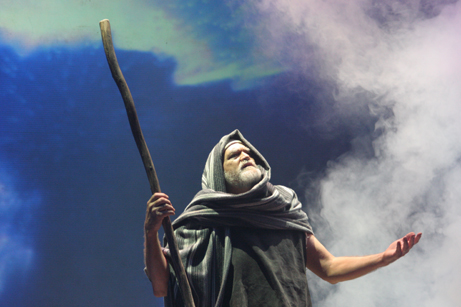
 God appeared to Moses in the burning bush and asked him, “What’s that in your hand?” Of course, whenever God asks questions (i.e. Adam, where are you?), God doesn’t need our information. He asks because he wants to accomplish something in our realization. In other words, identify this thing. Look at it, this dead, unproductive piece of wood. Then God said, “Throw it on the ground.” (Exodus 4) And from these verses, I heard a wonderful message from Jentzen Franklin of Chicago citing three good points about what’s in my hand…

The rod represented his identity. It was a shepherd’s staff.
It represented his income, an occupation that provided his trusted resource and living.
It also represented his sphere of influence, the world around him and where he lived.

He used a star football player from his congregation as an example and showed a slide of this man bowing the knee at the end zone and thanking God when he made a goal. He’s using his influence to point to God. It so happens a football is in this man's hand, but there he was, laying it down for God to get the glory. Some may not understand that, but what a refreshing contrast to the superstars who strut around the endzone thumping their chests like tribal warriors when they can run 100 yards carrying that little pigskin. No, this man was using what he had in humility, recognizing that it all came from God and publicly thanking Him for it. The Word encourages us, “Whatever you do, do it wholeheartedly as unto the Lord and not unto men.” (Col 3:23) This man was truly serving an audience of One.

 I noticed the three I’s in his outline, and it was a triple-punch to the solar plexus, or should I say,soular plexus? This is a solid reminder of the all-encompassing self-life. Me, myself and I. We could say, the mind, the heart and the soul. Or, some think of the will, emotion and being. All that I am needs to be surrendered at the feet of Jesus. How tightly am I holding on? Truly, nothing that is "in my hand" is permanent or dependable forever. All these things can be taken from me in an instant. But the God who gave me life can teach me how to use what He has put in my hand. I only  have to listen.

A popular commercial asks the question, "What's in your wallet?" Usually, a band of rogue warriors is trying to steal it from you. But who has the authority to ask such a question? Certainly the one who gave it to you could do that. God has the right to ask you for what's in your wallet. You wouldn't have a wallet, and there would be no photo on that license. There wouldn't even be a name printed there because you wouldn't have a breath without him! Like the disappearing faces on the old movie, Back to the Future, there would be no YOU! If we could only understand, it all belongs to Him and begins and ends with Him.

In every area of our lives, the Lord asks, "What’s in your hand?" He just wants us to recognize the gifts He's given us. We should have our eyes wide open and thankful hearts. There are bountiful blessings in our hands. There are families and children, friendships and opportunities, abilities, creativity and time! All so precious! Do we see all that is in our hands?

If so, the first step is God's command, "Throw it down!" It was just a dead stick in Moses’ hand, but when he obeyed God, casting it at his feet, it became a living thing! God knew he couldn't really use Moses until this weak and faltering lipped man realized a thing or two. It's as though God had to set the record straight.

Sometimes I wonder, shouldn't the burning bush have been enough? Was  that sight too remarkable, too distant or intangible for him to grasp? God went a step further. He demostrated his power with the very familiar staff in his own hand. Moses probably carved and then carried it for years, possibly for the forty years he had been a shepherd in that distant land. His hands must have known every minute crook and crevice of that staff. In a very real way, that chunk of wood represented his own life. 

It's as though the Lord was saying, Let me come a little closer and show you something you will really understand. You shaped that piece of wood, didn't you? You've used it and held onto it for many years. You think you have power over it? You think you have something special there, do ya? Wait til you see what I can do with that little stick! When it hit the ground it became a live snake and Moses ran from it! Moses had no idea the potential that was in that wooden stick. Potential for life as well as potential for death. In the same way that you carved that stick, I shaped you! Just as you've carried it and know it intimately, I've carried you and know you inside and out. I AM your creator and I'm calling you to trust me with everything that is in you.
 Later on, of course, this same "stick" touched the Red Sea and it opened up so that two million people could walk across on dry ground in one night. I've heard scoffers say things like, "Oh, it was low tide anyway. The water was probably just a few inches deep!" Wow, if that's true, then it is even more remarkable. God drowned the whole Egyptian army in a little stream of bath water and thousands of horses and chariots were covered on a sandbar! No, it's a cute joke, but I think not.

There have been excavations at the site where it happened at Nuweiba, a red granite pillar that was erected by Solomon that is still standing, and the gilded chariot wheels have been found on the ocean floor. The place is ten miles long and up to 5000 feet deep. Though many want to look the other way and pretend it never happened, the Red Sea was a dynamic miracle as God stretched out His bare arm and brought his people out of slavery, just as He promised.

The point is, that little "stick" was seriously promoted. It went from herding a bunch of sheep in the back side of the desert to commanding angels on the front lines of history! Moses' rod in God's hand called down plagues on their enemies and led them to the Promised Land. As Moses learned to listen to God's command, that little stick became the ruling rod of God on earth. From a shepherd's humble staff to a reigning scepter in the hand of the Almighty!
God takes whatever we have and he can do the unthinkable. He can bring things to life! For me it’s writing, speaking and teaching. It might be a bunch of words and the learning and the messages he’s put in my hand. Without his life-giving Spirit, without his blessing, these things would never accomplish a thing. They are just dead things like so many scratchings on pages or so many splinters of wood. But at God's command, even the very familiar can overpower me. Like a slithering serpent, I would run from these same words and be destroyed by them.

So I cast down my identity, I trust you God for the income and resources I need to live. My future, my security, the ability--it all comes from you. I cast the sphere of influence, the readers and writers' groups, the congregations or classrooms, the people I “bump” into along the way… WHEREVER it is and WHENEVER it is, Dear God, I throw it all at your feet in Jesus' Name.

Thank you, Father, for the wonderful things you have put in my hand, but God, help me never to cling to them more than you, or lean on them or trust in them for life. It is the giver, not the gifts that I seek. Like the rod of Moses, these things are powerless without you.

  Jesus said, "I am the vine; you are the branches. If a man remain in me and I in him, he will bear much fruit; apart from me you can do nothing." (John 15:5)
Source:http://faithwalkjourney.blogspot.com/2006/09/rod-of-moses.html

Monday, April 23, 2012

The God Who Refuses To Let You Die!


Are you looking for the meaning of life? Are you suffering from some major mistakes? Are you ashamed of what you had done? Is your past haunting you?


Type 51 Chinese Pistol
You are looking at the blog of a man who had been through all these. I was so embarrassed by my mistakes and sins that I had wanted to shoot myself in the head with a Chinese pistol.


After my pastoral ministry and marriage failed, I hid in Cambodia. The shame was unbearable. One night, I took out the Chinese pistol that I bought and put it to my head. A voice said that it would be better to end it all. I felt that not only the whole Christian community had condemned me... and worse than that, I felt that even God did not want me any more.


I had messed up and deserved to die! That voice kept ringing in my ears, pestering and pushing me into the deep darkness of that terrible night. Before I could pull the trigger, another louder voice suddenly thundered through the sound of my sobbing. That voice was loud but gentle. That voice said that God had not given up on me if I were not to give up on God.


The presence of God was suddenly in that room. When we hit bottom and have nowhere else to go, we can always be assured that God will be there. When all our friends and loved ones reject us, we can be assured that God would always be our comfort and joy.


Perhaps you can identify with me. You may have done things that you are really ashamed of. Perhaps you are living in fear that your dirty little secret might one day pop up and destroy your reputation and life. You may have been part of a good Church but no longer attending because you feel that God may not tolerate someone like you. You may feel that you are beyond hope.


If you feel that way, you are not the first. The Bible has many stories of people who messed up. One distinct difference is that they refused to stay messed up. They called upon God and rose up to take on new challenges. They understood the mercy and grace of God; they got back on the path of recovery. 


We may stumble and fall. We may be so ashamed of our mistakes and sins that we just want to wallow in our failure. We just don't want to try any more. Then God would come in the person of Jesus Christ who lovingly coax us on. With His nail-scarred hands, He would pick us up and put us on our feet again. God is the God of second, third, fourth, fifth... hundredth chance. As long as you still have life, the game is not over yet. 


Rev Albert Kang

Monday, April 16, 2012

You Can Humbly Soar

Being humble does not mean that you avoid having success in your ministry. Never get the wrong notion that being a success means being proud. There are many successful heroes of faith in the bible and they are very humble. 


Start seeing yourself growing strong in your ministry. Visualize yourself as succeeding and not failing. Discouragement may hit you but that does not mean that you have to take it lying down. 


God has created you to fly and not to crawl, to climb and not to fall, to succeed and not to fail. You are made for your God-given assignment and you must succeed. Keep soaring!

Wednesday, April 11, 2012

Jesus - High On The Mountain

When Christians say that they put Jesus first, I am afraid that what they mean is that they have created a little chapel on a very high mountain and leave Jesus there. After worshiping Him, they climb down and put their family next. Their church third and their career fourth and so on. 

Where is Jesus? High on the mountain. Once a while, they will climb up that mountain and spend 'quiet time' with Him. Then they are down again to their secondary priorities, struggling alone with their families, churches, careers and other aspects of life.

It is true that the Bible tells us that Jesus is first before and over all things (Colossians 1:15-20) but that does not mean that we put Him in the chapel on the high mountain. He only becomes first in our lives when He is able to be in the midst of them. After all He is the One who reconciles all things to Himself. In Him, all things hold together as all things were created through and for Him.

So, my advice is not to put Jesus 'first' on the mountain but invite Him down to our daily experiences and struggles of life and let Him be in the center of everything that we do.

Rev Albert Kang